









How Open-Ended Movement Unlocks Regulation, Core Strength, and Brain Power
As parents and educators, we often view active play as a simple way for children to burn off extra energy. But from an occupational therapy (OT) perspective, movement is far more than physical exercise—it is the ultimate foundation for brain development, self-regulation, and emotional stability.
To help us dive deep into the mechanics of playful learning, we sat down with Katie Zelinski, OTR/L, founder of The Well-Balanced OT. She shares how the intentional, open-ended design of Stapelstein® elements supports children’s nervous systems, physical milestones, and cognitive growth.


Calming the Nervous System – From Sensory Integration to Daily Regulation
If a child experiences sensory processing sensitivities, they can quickly become overwhelmed by unpredictable sensory input or avoid certain experiences altogether. When it comes to touch, children with tactile defensiveness (sensitivity to physical textures) often avoid messy or sticky foods. They might react with big emotions, immediately ask for a wet wipe, or attempt to wipe the substance onto their clothes.
Texture & Shape – Providing Tactile Safety for Sensitive Children
The smooth surface of a Stapelstein® element acts as a comfortable “sensory bridge” for children who are easily overwhelmed by textured materials.
“The Stapelstein® offers a smooth surface, which can feel more comfortable for children who become easily overwhelmed by more textured materials. This allows them to continue playing in a way that supports their nervous system, rather than working against it. It helps their feet feel safe when climbing and stepping on the elements, and their hands feel comfortable while engaging in different types of play.”
— Katie Zelinski, OTR/L
The 3 Powerhouse Sensory Systems Behind Focus & Attention
Many people assume active play disrupts focus, but OT principles reveal that movement actually supports a regulated body. A regulated child feels safe, allowing their internal energy level to match their environment—whether running at a noisy park or sitting quietly in a library.
To help a child feel grounded, OTs focus on three powerhouse sensory systems:
- The Vestibular System (Movement & Gravity): Keeps us upright whether we are running, sitting on a floor cushion, or working at a desk.
- The Proprioceptive System (Body Awareness): Helps us understand where our body is in space, allowing us to control force and move with coordination.
- The Tactile System (Sense of Touch): Processes physical inputs like temperature, friction, and texture.
When kids receive balanced input through these three systems, their nervous system becomes grounded, laying the foundation for better concentration.
Want to see how to use Stapelstein for energy-boosting play or calming sensory resets? Swipe through our step-by-step OT guide to Sensory Regulation on Instagram.
Building Confident Movers – From Gross Motor Skills to Postural Core Strength
When children engage with dynamic, elevated, or wobbly surfaces, they aren’t just practicing balance—they are building the postural stability required for everyday tasks.
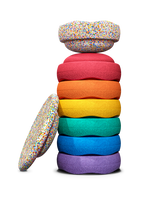
Standing on a stack of up to three Stapelstein® Original elements requires subtle body adjustments because the top surface is slightly rounded. This mild instability engages small muscles in the feet and body, activating the vestibular and proprioceptive systems to strengthen core muscles. Stepping onto a dynamic surface, such as a Stapelstein® Board, increases the challenge by requiring quick, reactive balance responses.
Developing postural strength is essential for academic and daily life skills, including handwriting, feeding, tying shoes, jumping, and reaching.
“For skilled hand use, like writing, feeding, stacking blocks, or stringing beads, the shoulder girdle needs to be stable so the hands can move with precision. At the same time, the core must be strong enough to hold the body upright. Think about trying to feed yourself while leaning far over the table, or writing while tipping to one side in your chair—it doesn’t work very well.”
— Katie Zelinski, OTR/L
Wobbly Surfaces & Building an Internal Risk-Assessment Compass
Beginning in infancy, children develop a “body map” through physical exploration—feeling different surfaces against their skin and sensing their body boundaries. As they grow, every small bump, climb, or minor fall provides sensory feedback that the brain retains. This fuels a key cognitive and physical skill called generalization: the ability to take what was learned from one movement and apply it to new, similar situations.
By practicing on dynamic, unstable surfaces indoors, children build a toolkit of movement patterns that directly strengthens motor planning. If a child never explores wobbly or elevated surfaces in a safe environment, their nervous system won’t know how to adapt when stepping on an unstable rock or a swinging bridge outdoors. Controlled risk-taking at home builds the spatial judgment, physical confidence, and adaptability needed to navigate unpredictable environments safely.


Looking for fun ways to hit physical milestones like two-footed jumping and standing balance? Take a look at our guide to Gross Motor Milestones & Balance Play
Expanding Young Minds – From Rule-Free Play to Executive Function & Spatial Logic
While physical development is obvious during movement, open-ended play is equally powerful for expanding cognitive architecture.
Ideation, Planning, and Problem-Solving Through Open-Ended Play
Executive functioning is a collection of mental skills that includes planning, organizing, sequencing, and problem-solving. When children play without rigid instructions, their brains practice ideation—the ability to generate original ideas.
A single open-ended element can transform into:
- A hat or a turtle shell
- A steering wheel or a seat
- A stepping stone, a bowl, or a cliff
Once a child forms an idea, they must plan how to execute it. If they decide an element is a car wheel, they have to figure out where they are sitting, how they are moving, and what happens next. When their structure tips over or doesn’t work as imagined, they engage in trial-and-error problem-solving. Experiencing small failures during play teaches flexible thinking and resilience.

Geometry in Action: Visual-Spatial Skills and Constructional Praxis
Interacting with objects that stack, nest, and interlock helps children understand how their bodies relate to 3D space. Stacking and path-building strengthen several key visual processing skills:
- Visual-Motor Skills: Coordinating eye movements with hand actions.
- Visual-Perceptual Skills: Identifying differences in size, shape, color, and depth.
- Visual-Spatial Skills: Understanding spatial concepts like on top of, next to, in front of, and directionality (left vs. right).
- Constructional Praxis: The ability to combine separate elements to build a new, cohesive structure.
Having trouble with a child who constantly waits for instructions on “how” to play? Learn more about the OT strategy ‘Model, Don’t Direct’ for independent play.
About the Expert
Katie Zelinski, MS, OTR/L is a pediatric Occupational Therapist (NYU alum) with nearly a decade of experience spanning Early Intervention, school systems, and Ayres Sensory Integration clinics. As the founder of The Well-Balanced OT, she empowers caregivers and therapists through parent support sessions, webinars, and sensory processing education.
You can find her at thewellbalancedot.com and on Instagram @the.well.balanced.ot.

